Celebrating 45 Years of clinical innovation, comfort, and caregiver support at Broda.

Explore the Legacy!

How to Choose the Best Rolling Shower Chair Commode?

Choosing the right rolling shower chair commode can change a difficult bathing routine into a safer, calmer experience. It must support hygiene, transfers, comfort, and caregiver control. A suitable chair should roll smoothly across wet floors, fit through bathroom doors, and remain stable beside the toilet or shower.

Start with the user’s real measurements and daily needs. Check seat width, seat height, weight capacity, caster size, and brake access. A padded seat may feel comfortable, but some materials retain moisture or become difficult to clean. Drainage openings, removable footrests, and adjustable armrests can make personal care easier. Small details matter.

Safety deserves careful attention. Look for a strong frame, reliable locking casters, corrosion-resistant materials, and clear manufacturer instructions. Clinical guidance or advice from an occupational therapist can help when balance, pressure relief, or transfer assistance is involved. Caregivers should test the chair slowly before using it in a shower. Wet surfaces expose weaknesses quickly.

No chair is perfect. A model that rolls well may feel bulky in a small bathroom. A lightweight frame may sacrifice some stability. I would not judge comfort from a product photo alone. Sit in the chair, inspect the seams, and check whether the commode opening aligns properly. Maintenance also matters, because neglected wheels and damp hardware can reduce performance. This guide explains the practical features, questions, and compromises that help families choose with greater confidence. ҡа
How to Choose the Best Rolling Shower Chair Commode?

Understanding Rolling Shower Chair Commodes and Their Main Functions

How to Choose the Best Rolling Shower Chair Commode?

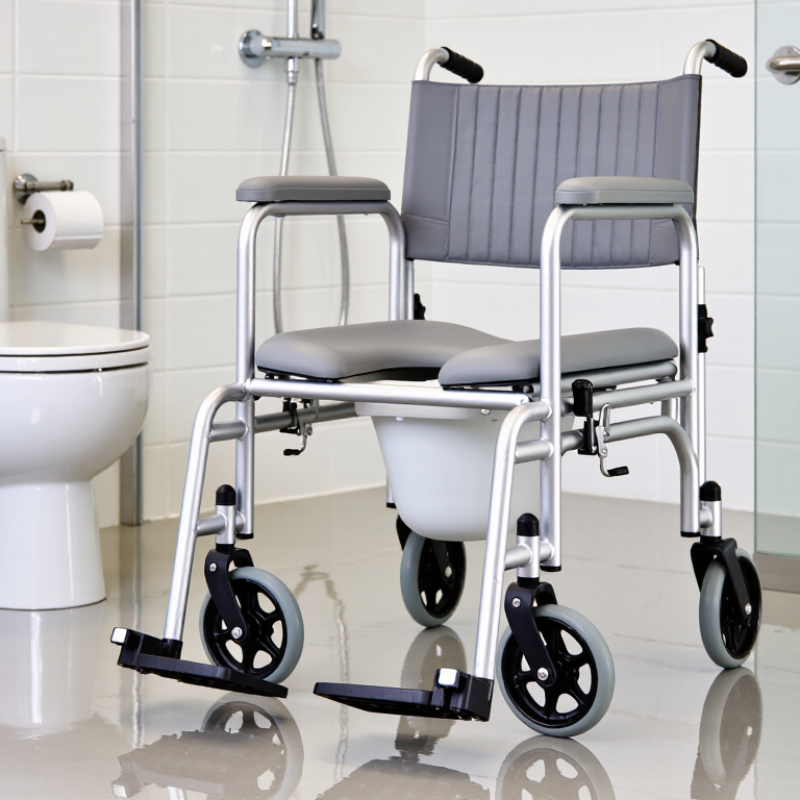
A rolling shower chair commode combines bathing, toileting, and mobility support. Its waterproof seat usually includes a hygiene opening and a removable container. Lockable casters help caregivers position the chair beside a bed or over a toilet.

According to the CDC’s 2021 Older Adult Falls Data, about one in four older adults reports a fall annually. Therefore, secure brakes and controlled movement are basic safety features, not luxury details. A small mistake matters.

Evaluate the chair around the user’s real routine. Measure bathroom doors, toilet height, and turning space before purchasing. Check seat width, seat depth, armrest clearance, and the user’s weight. Footrests should support the legs without blocking transfers.

Padded surfaces can improve comfort, but they may retain moisture if cleaning is difficult.

The WHO reports that falls are the second leading cause of unintentional injury deaths worldwide. This reinforces the need for stable transfers and dry, easy-to-clean materials.

Caregivers should test the brakes, wheel movement, and commode container before regular use. The chair should move smoothly over the actual bathroom floor, not only a showroom surface. Look for corrosion-resistant hardware and clearly stated weight limits.

Some designs feel secure but turn poorly in narrow rooms. That detail is easy to miss.

User comfort also deserves attention, because pain or embarrassment can reduce cooperation and increase transfer risk. Professional assessment remains wise when balance, pressure injuries, or complex medical needs are present.

Assessing User Needs, Mobility, and Bathroom Safety Requirements

Choosing a rolling shower chair commode starts with the person, not the equipment. The World Health Organization’s 2021 Falls fact sheet reports about 684,000 fatal falls worldwide each year. Older adults face the greatest risk. The CDC also reports that more than one in four adults aged 65 and older falls annually. Bathroom transfers deserve careful attention.

Assess walking ability, trunk control, hand strength, and fatigue during bathing. A user who walks short distances may still need full support after toileting. Measure the doorway, toilet height, shower threshold, and turning space. Check the chair’s seat width, depth, weight capacity, and commode opening. Lockable casters matter. So do adjustable footrests and padded arm supports. Small details can prevent awkward reaching.

A smooth floor does not guarantee safe movement. Water, rugs, and narrow turns can change the risk quickly. The CDC’s older-adult fall data links many falls with injuries requiring medical care or activity limits. A caregiver should test transfers slowly, with the user’s usual clothing and footwear. Never rely on the product label alone. Real bodies do not fit standard measurements perfectly. That is the uncomfortable part. A therapist or qualified clinician may notice risks that a home checklist misses. Reassess after illness, surgery, or reduced strength. A chair that worked last month may no longer provide enough support.

Comparing Chair Features, Materials, Sizes, and Weight Capacities

How to Choose the Best Rolling Shower Chair Commode?

The WHO and UNICEF Global Report on Assistive Technology (2022) estimates that 2.5 billion people need assistive products worldwide. That figure may reach 3.5 billion by 2050. A rolling shower chair commode should support daily hygiene, transfers, and caregiver control. Look for locking casters, reachable brakes, adjustable footrests, and armrests that do not obstruct transfers. Test the brakes on wet flooring. Small design details matter.

Materials affect comfort and maintenance. Aluminum usually reduces weight, while stainless steel offers strong corrosion resistance. However, stainless steel can feel cold and increase chair weight. A molded polyurethane seat often feels warmer than hard plastic. Openings should provide access without creating sharp pressure points. The CDC reported that 27.7% of U.S. adults had a disability in 2022, including mobility limitations. Users therefore need different support levels, not one universal design.

Measure the user’s hip width, bathroom doorway, toilet height, and turning space. Add clearance for clothing and caregiver movement. The seat should feel stable without squeezing the thighs. Check weight capacity carefully. Include body weight, clothing, shower water, and caregiver assistance during transfers. A 300-pound rating may be inadequate for a 280-pound user receiving hands-on support. The WHO emphasizes person-centered assistive technology, but product labels rarely explain real transfer loads. That gap deserves attention. Fit matters. Stability matters more.

Evaluating Comfort, Hygiene, Maneuverability, and Transfer Support

Choosing the best rolling shower chair commode requires more than checking weight capacity. Comfort affects bathing time, skin protection, and cooperation. A contoured, padded seat can reduce pressure, but excessive softness may hold moisture. That matters. Check the seat width, back support, and leg position with the user seated. Footrests should support the heels without pressing behind the knees. Caregivers often notice discomfort before users explain it, especially when communication is limited.

Hygiene depends on accessible surfaces and drainage. Look for a commode opening that aligns correctly and allows simple cleaning. Smooth, sealed materials usually reduce residue buildup. Removable components can help, although loose parts may be misplaced. Use the care instructions and inspect seams, hinges, and padding regularly. A washable cover is useful, but it does not replace thorough cleaning between uses. I would avoid choosing a chair only because it looks easy to sanitize.

Maneuverability and transfer support must match the bathroom layout. Test the chair over thresholds, around the toilet, and beside the shower. Large rear wheels may improve control, while smaller wheels can save space. Lockable casters should engage fully before any transfer. Swing-away or removable armrests can create a safer lateral transfer path. A height-adjustable frame may align better with the bed or toilet, but incorrect settings can increase sliding risk. An occupational therapist or qualified healthcare professional should assess transfer ability, trunk control, and caregiver technique before purchase.

How to Choose the Best Rolling Shower Chair Commode? - Evaluating Comfort, Hygiene, Maneuverability, and Transfer Support

Evaluation Dimension Practical Benchmark What to Evaluate Why It Matters Verification Method
Seat Width and Depth Common seat widths are approximately 16–20 in (41–51 cm), with a depth of about 16–18 in (41–46 cm). Allow enough room for the user’s hips without creating excessive side-to-side movement. The seat should support the thighs without pressing behind the knees. Correct sizing improves stability, pressure distribution, and sitting tolerance during bathing or toileting. Measure hip width while seated and compare it with the usable seat dimensions, not only the outside frame width.
Weight Capacity Select a rated capacity that exceeds the user’s body weight and any additional transfer load; a safety margin of at least 10% is practical. Check whether the capacity applies to the complete chair, including the commode bucket, footrests, and accessories. A suitable capacity supports structural stability and reduces the risk of overloading during transfers. Read the product’s maximum user-weight rating and confirm that it covers the intended use.
Seat Comfort and Pressure Management Look for a contoured, padded, or pressure-distributing seat with a smooth, sealed surface. Assess cushioning firmness, edge pressure, drainage openings, and compatibility with a clinically recommended pressure-relief cushion. Comfort can affect sitting time, posture, skin protection, and willingness to use the chair consistently. Inspect the seat in person when possible and ask a healthcare professional about pressure-injury risk.
Hygiene and Cleanability Prefer non-porous, corrosion-resistant surfaces, removable upholstery, and a removable commode pail or access opening. Check for seams, exposed screw heads, narrow crevices, and components that can be removed for cleaning. Fewer hard-to-clean areas help reduce odor, residue buildup, and cross-contamination. Review cleaning instructions and confirm which disinfectants are safe for each material.
Commode System A removable pail, splash guard, secure lid, and easily replaceable liner or pan are useful features. Evaluate pail capacity, handle design, odor control, clearance, and whether the chair can be positioned over a toilet. A practical commode system simplifies toileting and limits unnecessary lifting or bending. Test pail removal with the user seated, if safe, and measure toilet clearance before purchase.
Wheel and Caster Size Common rolling shower chairs use casters around 3–5 in (7.5–12.5 cm); larger casters generally handle thresholds better. Consider caster material, swivel action, floor contact, and compatibility with wet bathroom surfaces. Caster design affects rolling resistance, directional control, and the ability to cross small floor transitions. Measure door thresholds and test movement on the actual bathroom floor when possible.
Brakes and Stability Look for locking mechanisms on all rolling points or a design that provides a stable, manufacturer-approved braking configuration. Brakes should be easy for the caregiver to engage and should remain accessible when the chair is positioned near a toilet or shower. Reliable brakes help prevent unintended movement during transfers, bathing, and toileting. Apply each brake and gently test the chair for movement before transferring the user.
Maneuverability A compact frame and tight turning capability are important; many bathrooms require a clear passage of at least 30–32 in (76–81 cm). Check overall width, turning radius, wheel clearance, and the ability to approach the toilet or shower from the required direction. Good maneuverability reduces caregiver effort and lowers the chance of contact with walls, fixtures, or door frames. Measure doorways, hallway turns, shower entry points, and toilet clearance before selecting a frame size.
Transfer Support Useful features include removable or swing-away armrests, flip-up footrests, a low transfer height, and a stable backrest. Confirm that arm supports do not obstruct lateral transfers and that footrests can be moved out of the way before standing or pivoting. Transfer-friendly components can reduce twisting, reaching, and lifting demands for both user and caregiver. Have a qualified caregiver or therapist assess the intended transfer technique.
Adjustability and Fit Height-adjustable components are valuable when the user, toilet, shower, and transfer surfaces have different heights. Evaluate seat height range, footrest adjustment, armrest height, and compatibility with the user’s leg length. Correct height supports safer positioning and may reduce strain on the knees, hips, and caregiver’s back. Measure the user’s seated height and the height of the toilet or shower surface.
Material and Corrosion Resistance Aluminum, stainless steel, and sealed medical-grade plastics are commonly used for wet-area equipment. Check frame coating, fasteners, drainage points, and whether materials are suitable for repeated exposure to water and disinfectants. Corrosion-resistant construction supports durability and helps preserve brake and frame performance. Inspect the care manual for drying, storage, and approved cleaning-product requirements.
Caregiver Handling and Storage A lighter frame, push handles, folding components, and tool-free adjustments can improve daily usability. Consider total chair weight, folded dimensions, lifting points, and whether one caregiver can safely move it. A chair that is difficult to move or store may not be used correctly or consistently. Compare the chair’s weight with the caregiver’s safe handling ability and available storage space.
Safety and Clinical Suitability The chair should match the user’s balance, trunk control, mobility, continence, skin condition, and transfer method. Assess the need for a safety belt, lateral supports, tilt or recline, head support, or specialized pressure management. The best feature set depends on the individual’s functional needs rather than chair specifications alone. Request an evaluation from an occupational therapist, physical therapist, or other qualified healthcare professional when risk is elevated.
Selection note: Dimensions and capacity ratings vary by model. Confirm the manufacturer’s current specifications, user instructions, and cleaning requirements before use. A qualified healthcare professional should assess users with significant weakness, poor balance, pressure-injury risk, or complex transfer needs.

Choosing, Using, and Maintaining the Most Suitable Model

Choosing the right rolling shower chair commode starts with the user, not the catalog. Measure the bathroom doorway, shower threshold, toilet height, and turning space before comparing models. Check the stated weight capacity, seat width, back support, footrests, and wheel size. An occupational therapist or qualified clinician can assess posture, transfer ability, and pressure risks. Ask for measurements in writing. Fit matters. Small gaps often cause large problems.

During use, lock all casters before transfers, even on a level floor. Keep feet supported and move slowly across wet surfaces. Use the commode pan or position the chair directly over the toilet, according to its design. Never assume the brakes are engaged. Caregivers should explain each movement and watch for dizziness, skin redness, or sliding. Privacy matters too. That detail is easy to overlook.

After each use, rinse away soap and body fluids, then dry joints and upholstery. Follow care instructions for disinfectants, because harsh chemicals may weaken plastic or metal finishes. Inspect bolts, wheel locks, armrests, and welds weekly. Replace loose or damaged parts before the next transfer. Check the pan seal and cushion for cracks. Honestly, maintenance is often postponed when routines become tiring. That is where reliability starts to decline. Record inspections on a simple calendar, and request professional service when a defect remains unclear.

How to Choose the Best Rolling Shower Chair Commode

Practical evaluation priorities for choosing, using, and maintaining a suitable model

The chart uses a 100-point decision framework. Safety and stability receive the greatest weight, followed by fit, adjustability, rolling performance, hygiene, transfer accessibility, and user comfort. Before use, confirm the chair’s safe working load, bathroom clearances, brake function, seat dimensions, and compatibility with the toilet or shower area.