What Is Silk Covered Litz Wire Used For?
silk covered litz wire is designed for windings where high-frequency performance and flexible handling matter. It bundles many fine, individually insulated strands to help reduce skin and proximity effects compared with a single solid conductor. A silk or textile covering holds the bundle together and provides a practical outer layer during winding. It is not a substitute for checking the strand insulation or the finished coil’s requirements.
You may find this wire in high-frequency transformers, inductors, and selected radio-frequency or audio equipment. In a compact transformer, for example, its flexible bundle can follow a tight winding path around a bobbin. The silk covering can also help limit fraying and make the wire easier to handle. Small details matter. Performance depends on strand diameter, strand count, operating frequency, current, and winding geometry—not the covering alone. A silk covered litz wire specification should also be checked for temperature rating, insulation system, and compatibility with the intended process. There is no single best construction. Even a carefully chosen wire can disappoint if the frequency range or thermal conditions are misunderstood. That is worth remembering. This article explores where silk covered litz wire is used, what its covering contributes, and which design details deserve a closer look.
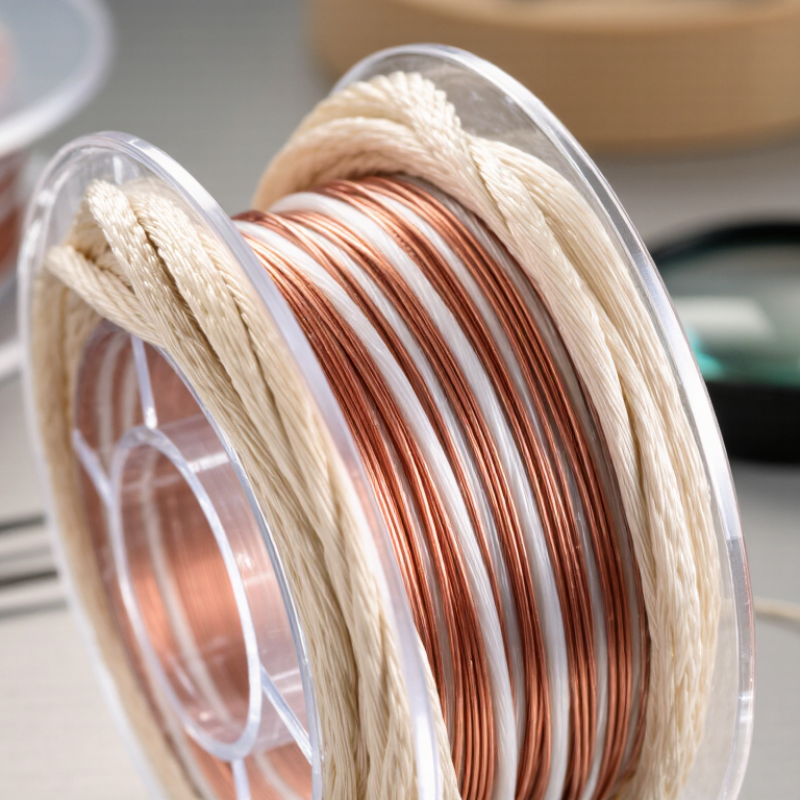
What Defines Silk-Covered Litz Wire: Individually Insulated Strands in a Silk Wrap
Silk-covered litz wire consists of many fine copper strands gathered into a flexible bundle. Each strand carries its own thin electrical insulation, commonly enamel. The strands are bundled and enclosed in a silk or silk-like textile wrap. That distinction matters. The strand insulation separates neighboring conductors, while the wrap helps contain the bundle and gives it a smooth, pliable surface. It is not a substitute for the strand insulation or for any required insulation system around a finished coil.
The construction is used in coils, inductors, and transformers where alternating current can concentrate near conductor surfaces and increase losses. Fine, individually insulated strands can help reduce that effect when the litz wire is properly designed and assembled. The textile covering can also make the bundle easier to guide around a bobbin or through a compact winding space. Think of a close turn around a small core: a stable bundle is less likely to fray during careful handling. Still, silk covering alone does not guarantee lower losses or a suitable operating temperature. Strand count, wire size, frequency, winding geometry, and insulation ratings all matter. It is easy to overstate the wrap’s role; its value is practical, but the electrical design does the heavier work.
How Silk Covering Supports Abrasion Resistance and Coil-Winding Stability
Silk-covered litz wire is used in coils where many fine, insulated strands need a protective outer wrap. The strands can carry high-frequency current with reduced skin and proximity effects, depending on the wire and coil design. Silk gathers the bundle and provides a soft buffer against rubbing during winding. It helps, but it is not abrasion-proof.
That buffer matters when wire passes guides, crosses earlier turns, or bends around a bobbin edge. A more orderly bundle can also reduce snagging and uneven spacing, supporting steadier coil winding. Silk does not control tension by itself. In practice, a sharp guide or excessive pull can still damage the covering. Results vary, and the winding setup deserves attention.
Tips: Check guide surfaces for burrs, use smooth winding paths, and follow the wire supplier’s tension guidance. Inspect sample coils under magnification. A small test run often reveals problems before full production. Don’t assume the wrap will fix poor handling.
Why Strand Diameter Matters: Copper Skin Depth Is About 0.21 mm at 100 kHz
At 100 kHz, copper skin depth is about 0.21 mm. This is a reference, not a magic boundary. In a solid conductor, alternating current crowds toward the surface, leaving less copper effectively used. Silk-covered Litz wire divides the conductor into many fine, individually insulated strands. When strand diameter is well below the skin depth, current distribution can improve and AC resistance may fall. The strands are transposed along the bundle, helping each occupy different magnetic positions. Silk wrapping holds the bundle neatly and adds a soft protective layer. It does not replace strand insulation.
For example, a high-frequency winding may run cooler with suitably fine Litz strands than with one thick copper wire. But strand size alone cannot predict performance. Frequency, current, bundle geometry, termination quality, and nearby magnetic fields matter too. A 0.4 mm strand exceeds the 0.21 mm skin-depth figure at 100 kHz, while finer strands may be a better starting point. Not a guarantee. Designers should check the wire construction and measure winding loss in the intended assembly. Silk can ease handling, though its thickness may affect packing space. Choosing wire means balancing AC loss against practical details like stripping and soldering. That trade-off is easy to underestimate.
What Is Silk-Covered Litz Wire Used For?
Copper skin depth decreases as frequency rises, making strand diameter an important consideration in high-frequency winding design.
At 100 kHz, copper skin depth is about 0.21 mm (approximately, for copper at 20°C). Litz-wire strands are individually insulated and transposed to help reduce AC losses; silk covering provides an outer protective wrap for handling and winding. Strand sizing is a design choice—not a strict cutoff—and also depends on proximity effect, waveform, and winding geometry.
Where It Is Used: High-Frequency Transformers, Inductors, and Wireless Charging Coils
Silk-covered Litz wire is used in high-frequency transformers and inductors where winding losses and tight turns matter. Its many individually insulated strands help limit skin-effect and proximity-effect losses, while the silk serving protects the bundle and makes it easier to handle. In a compact transformer, that can mean winding neatly around a small bobbin without scraping insulation. Results still depend on strand size, frequency, current, and winding geometry.
Wireless charging coils also use this wire, especially when designers need flexible coils with controlled resistance. The International Energy Agency’s Global EV Outlook 2024 reported nearly 14 million electric car sales in 2023, about 18% of global car sales. That figure signals growing power-electronics demand, though it does not measure wireless-charging adoption specifically. A practical detail: coil performance depends on the full magnetic and thermal design, not the wire alone. A tidy winding is not automatically an efficient one.
Tips: Check the wire’s specified frequency range, strand count, and insulation system against the actual operating conditions. Silk serving can aid handling, but it should not replace verification of electrical insulation and temperature limits.
How Engineers Specify It: Operating Frequency, Current, Strand Count, and Insulation Class
What Is Silk Covered Litz Wire Used For?
Engineers specify silk covered litz wire by operating frequency, RMS current, strand count, and insulation class. At higher frequencies, skin and proximity effects can increase copper losses. Using copper resistivity of 1.68 × 10⁻⁸ Ω·m at 20°C, the calculated skin depth is about 0.21 mm at 100 kHz. This is a useful estimate, not a finished design rule; winding geometry and nearby conductors also matter. (NIST reference data; IEC 60216 describes methods for evaluating electrical insulation’s thermal endurance.) Choose strand diameter against the operating frequency, then verify temperature rise in the actual coil.
Current capacity depends on the total copper area, cooling, duty cycle, and acceptable temperature rise—not strand count alone. More, finer strands may reduce high-frequency losses, but they add insulation area and can make terminations harder. Specify strand count and diameter together, plus the twist or transposition, finished bundle size, and silk covering requirements. State the insulation class for the enamelled conductor and confirm it against the expected hot-spot temperature; silk covering alone does not define that class. IEC 60317 provides specifications for particular winding-wire types, so identify the applicable construction rather than naming a class loosely.
Tips: Share frequency, waveform, RMS current, ambient temperature, and winding dimensions with the supplier. Check the hot spot. A bench test may still reveal losses your calculation missed.
What Is Silk Covered Litz Wire Used For? - How Engineers Specify It: Operating Frequency, Current, Strand Count, and Insulation Class
| Typical operating frequency | Example application | Example bare strand diameter | Example strand count | Approx. copper area | Illustrative current at 3 A/mm² | Insulation-class guidance |
| 20–50 kHz | Switch-mode power transformers and larger inductors | 0.10 mm | 50 | 0.393 mm² | 1.18 A | Select the class for the complete insulation system and required winding temperature; silk covering alone does not establish a thermal class. |
| 50–200 kHz | Resonant converters, high-frequency transformers, and compact inductors | 0.05 mm | 100 | 0.196 mm² | 0.59 A | Specify a recognized thermal class, such as 155 or 180, only when the full insulation system is rated and suitable for the design. |
| 200 kHz–1 MHz | High-frequency resonant magnetics and RF power inductors | 0.03 mm | 200 | 0.141 mm² | 0.42 A | Check the temperature rating of the strand insulation, silk yarn, and any impregnation or varnish as a combined system. |
| 1–3 MHz | RF coils and specialized high-frequency windings | 0.02 mm | 300 | 0.094 mm² | 0.28 A | Confirm dielectric strength, voltage requirements, and the supplier’s thermal-class data for the finished wire construction. |
Engineering notes: These strand counts and currents are illustrative examples, not wire ratings. Copper areas are calculated from strand diameter and count; illustrative currents use an assumed current density of 3 A/mm². Actual allowable current depends on temperature rise, cooling, duty cycle, winding geometry, proximity effect, and the full waveform. Strand diameter is typically chosen with skin effect in mind; copper skin depth is approximately 0.46 mm at 20 kHz, 0.21 mm at 100 kHz, and 0.066 mm at 1 MHz at room temperature. Silk is an outer covering that can improve handling and abrasion protection; each litz strand still needs its own electrical insulation, and the strands should be suitably transposed or bunched for the design.