Celebrating 45 Years of clinical innovation, comfort, and caregiver support at Broda.

Explore the Legacy!

2026 Best Cohesive Bandage Manufacturers for Global Buyers

Choosing the right Cohesive Bandage Manufacturer requires more than comparing prices and product photographs. Global buyers need consistent elasticity, reliable self-adherence, clean edges, and packaging that survives long-distance shipping. A bandage may look acceptable in a sample box but fail when wrapped around a moving ankle.

Industry data shows continued demand for advanced wound-care and medical adhesive products. Grand View Research’s medical tapes market analysis links growth to outpatient treatment, sports medicine, and home healthcare. Fortune Business Insights also identifies rising healthcare access and chronic wound management as important market drivers. These trends create opportunities, but they also increase supplier risk. Published market estimates vary, and buyers should examine the methodology behind each report.

This 2026 guide evaluates manufacturers through practical evidence, including production experience, quality systems, material control, and international fulfillment capability. Key checks include latex-free options, breathable nonwoven fabrics, cohesive performance, roll length accuracy, and lot-level traceability. ISO 13485 certification can indicate a structured quality-management process, although certification alone does not guarantee product consistency. It is only one piece of evidence.

Real-world verification matters. Request samples from different production lots. Test adhesion after storage, compression, and light moisture exposure. Review certificates, inspection records, complaint handling, and export documentation. Some suppliers communicate well but provide weak technical records. Others offer impressive factories but limited customization support. No manufacturer is perfect. Careful comparison remains essential. The following selection highlights manufacturers that may support hospitals, distributors, sports-care brands, and private-label buyers across global markets.
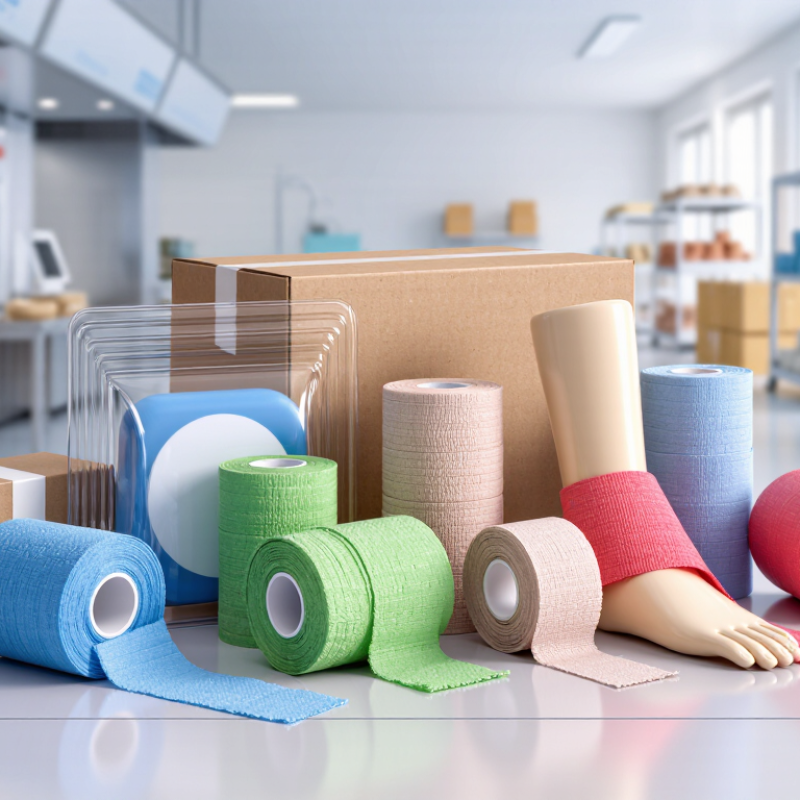
2026 Best Cohesive Bandage Manufacturers for Global Buyers

Cohesive Bandages: Definition, Uses, and Key Product Features

Cohesive bandages are self-adhering wraps that stick to themselves, not directly to skin or hair. They provide light compression, support, and protection without clips or adhesive tape. Common uses include securing dressings, stabilizing fingers, covering mild sprains, and supporting sports injuries. They are not sterile wound coverings. Open wounds still need an appropriate primary dressing.

A reliable cohesive bandage should offer consistent stretch and controlled compression. Excessive tension may restrict circulation, while weak elasticity can cause slipping. Width, roll length, edge quality, and tearability also affect daily handling. Breathable fabric helps reduce moisture buildup during extended wear. Latex-free options may suit users with known sensitivities, but material declarations should be checked carefully.

In clinical and field experience, texture matters more than attractive packaging. A soft, even surface usually wraps more comfortably around joints and uneven body areas. Secure bonding is important, yet removal should not pull the skin sharply. Color coding can help organize supplies, though it does not prove performance. Buyers should review testing data, batch traceability, shelf life, and storage requirements before placing large orders. No bandage performs perfectly in every climate. Heat, humidity, and dust can change handling characteristics. Small sample trials often reveal problems that product sheets miss. Manufacturers should explain compression guidance clearly and provide consistent samples for evaluation.

How to Evaluate Cohesive Bandage Manufacturers in 2026

Choosing cohesive bandage manufacturers in 2026 requires more than comparing price lists. Global buyers should examine production experience, material consistency, and documented quality controls. Ask how the manufacturer tests stretch, adhesion, skin comfort, and residue after removal. A reliable supplier should provide batch records, traceability details, and clear shelf-life information.

Request recent samples from different production batches. Check whether the bandage wraps smoothly around fingers, ankles, and irregular joints. It should hold firmly without feeling excessively tight. Review packaging strength, labeling accuracy, and storage instructions. Manufacturers with trained quality teams should explain their testing methods without vague promises. They should also understand destination-market requirements and provide suitable technical documents.

Tips: Compare at least three samples. Record your own test results. Ask about minimum order quantities, production capacity, and typical lead times. Confirm how complaints are investigated and corrected. A factory tour or live video audit can reveal cleanliness, inspection steps, and manual handling risks. Still, no checklist is perfect. A polished sample may not represent every shipment, and buyers can overlook small packaging defects. Consider independent testing for large orders, especially when skin contact, long storage, or multiple climates are involved. Reliable cooperation depends on evidence, communication, and consistent follow-up rather than impressive claims.

2026 Best Cohesive Bandage Manufacturers for Global Buyers

How to Evaluate Cohesive Bandage Manufacturers in 2026

The chart presents a practical 100-point evaluation framework for cohesive bandage manufacturers. Buyers should give the greatest weight to product quality and safety, regulatory readiness, supply reliability, and documented performance. Verification may include ISO 13485 quality-system certification, material and biocompatibility documentation where applicable, packaging validation, batch traceability, testing reports, and export capability.

Top Manufacturing Regions and Global Supplier Capabilities

2026 Best Cohesive Bandage Manufacturers for Global Buyers

Top Manufacturing Regions and Global Supplier Capabilities

In 2026, global buyers are comparing regions, not just factory prices. The strongest suppliers combine stable output, trained operators, and documented quality controls. East Asia often provides high-volume knitting, automated cutting, and flexible packaging options. India has expanded its capabilities in cotton, elastic, and latex-free cohesive materials. Turkey and nearby production hubs offer shorter delivery routes across Europe, the Middle East, and North Africa. European manufacturers usually emphasize specialized medical textiles, traceability, and strict process documentation. North American facilities often support customized formats and regulated distribution channels. No region is perfect.

Experienced sourcing teams should inspect the production process directly or request detailed evidence. A capable factory can explain fiber composition, adhesive behavior, roll tension, and storage conditions without vague answers. Buyers should review batch records, tensile testing, skin-contact evaluations, and packaging controls. Sample rolls should be checked for even adhesion, clean edges, easy tearing, and consistent compression. Small details matter.

Supplier capability can change quickly. A factory may operate excellent equipment but struggle during seasonal demand. Another may offer low prices while relying on manual inspection. That is a warning sign. Buyers should confirm production capacity, backup material sources, audit access, and shipment history. Certifications can support trust, but they do not replace practical verification. Some suppliers also need stronger communication across time zones. This weakness is easy to overlook, yet it can delay corrective action when a batch shows inconsistent stretch.

2026 Best Cohesive Bandage Manufacturers for Global Buyers - Top Manufacturing Regions and Global Supplier Capabilities

Manufacturing Region Common Product Formats Material and Construction Capabilities Typical Application Segments Quality and Regulatory Documentation Buyers Commonly Request Packaging and Customization Capabilities Best Fit for Global Buyers
China Elastic cohesive rolls Veterinary wraps Sports-support wraps Pre-cut formats Non-woven, cotton-blend, polyester, and elastic textile substrates; cohesive fixation through latex or synthetic polymer coating; multiple widths, lengths, colors, and stretch levels. First-aid distribution, sports medicine, veterinary care, wound-care kits, and general medical-supply channels. ISO 13485 quality-management certification where applicable; material specifications; test reports for tensile strength, elongation, adhesion, and skin-contact safety; market-specific product registration or technical files. Individual wrapping, dispenser boxes, bulk cartons, private-label artwork, multilingual labeling, barcode application, and customized dimensions are commonly available. Buyers seeking broad product variety, flexible customization, and scalable export-oriented production.
India Elastic bandage rolls Self-adherent wraps Cotton-based formats First-aid pack components Cotton, polyester, rayon, and blended substrates; elastic knitted or non-woven constructions; latex-containing and latex-free options may be offered depending on the production line. Hospitals, pharmacies, first-aid distributors, sports-care suppliers, veterinary channels, and institutional procurement. ISO 13485 documentation may be available; buyers commonly request batch traceability, product specifications, biocompatibility information for skin-contact materials, and country-specific conformity documents. Retail cartons, medical kits, bulk institutional packaging, printed labels, export cartons, and size or color customization are commonly supported. Buyers balancing competitive manufacturing costs with established textile and medical-disposable production expertise.
Vietnam Non-woven cohesive wraps Elastic support bandages Veterinary applications OEM formats Non-woven and textile-based elastic constructions; cohesive adhesive coatings; standard medical widths and customized roll dimensions depending on the supplier's converting equipment. General wound-care supply, sports support, veterinary care, retail first aid, and contract-packaged medical products. Buyers commonly request ISO 13485 certification, quality-control procedures, adhesive and substrate specifications, lot records, and documentation aligned with the destination market. Individual sachets, cartons, bulk export packs, private-label printing, and mixed-size carton programs may be available. Buyers looking for an additional Southeast Asian sourcing base and diversified supply-chain options.
Turkey Elastic cohesive bandages Compression-support formats Non-woven wraps Retail medical packs Textile and non-woven substrates with elastic recovery; cohesive coatings for self-adherence; products may be supplied in different stretch levels and widths. European, Middle Eastern, North African, hospital, pharmacy, sports, and first-aid distribution channels. EU-market buyers commonly request CE-related technical documentation under Regulation (EU) 2017/745 where applicable, ISO 13485 evidence, risk-management records, and product test reports. Retail-ready cartons, multilingual labeling, private-label packaging, export pallets, and regional distribution packaging are commonly available. Buyers prioritizing geographic proximity to Europe, the Middle East, and North Africa.
Germany and Western Europe Medical-grade cohesive wraps Latex-free options Compression-support products Specialized clinical formats Engineered non-woven and textile substrates; controlled elastic performance; latex-free synthetic adhesive systems; emphasis on consistency, traceability, and documented skin-contact performance. Hospitals, professional wound care, rehabilitation, sports medicine, pharmacies, and regulated healthcare procurement. ISO 13485, ISO 14971 risk-management documentation, technical files, clinical or performance evidence where required, material declarations, and EU MDR conformity documentation may be requested. Controlled-room production may be available for selected products; serialized or lot-traceable packaging, multilingual labels, and regulated-market documentation are common strengths. Buyers requiring strong documentation, process control, traceability, and mature regulated-market support.
United States and Mexico Self-adherent bandages Sports and athletic wraps Veterinary wraps First-aid kit formats Non-woven, elastic textile, and synthetic cohesive constructions; latex-free products, high-stretch options, colored wraps, and application-specific formats may be available. U.S. and North American medical distribution, sports medicine, occupational safety, veterinary care, emergency kits, and retail first aid. Buyers commonly request FDA establishment or product-related documentation where applicable, ISO 13485 evidence, complaint-handling procedures, lot traceability, biocompatibility information, and U.S. labeling compliance. Retail blister packs, cartons, institutional packs, bilingual English-Spanish labeling, private-label programs, and North American distribution packaging are commonly supported. Buyers prioritizing regional inventory, shorter North American lead times, and local regulatory or distribution support.

Buyer verification note: Capability descriptions are regional manufacturing patterns rather than rankings. Before purchasing, verify the supplier's current certifications, product classification, adhesive composition, latex status, test reports, labeling requirements, lot traceability, and destination-market conformity documentation.

Quality Standards, Certifications, and Regulatory Compliance

2026 Best Cohesive Bandage Manufacturers for Global Buyers

Quality standards should guide every manufacturer comparison. For cohesive bandages, buyers should review material composition, elasticity, tensile strength, adhesion, and controlled unwind performance. A reliable supplier can provide test reports for skin contact, color stability, aging, and package integrity. Small details matter. A loose wrapper can compromise cleanliness during storage and transport.

Manufacturers serving medical markets should maintain a documented quality system, commonly aligned with ISO 13485. Depending on the destination and product claims, additional registration, conformity assessment, or market authorization may apply. Buyers should verify certificate scope, issuing body, validity dates, and covered production sites. Do not accept a certificate image alone. Request traceable evidence.

Regulatory compliance also depends on labeling, intended use, risk classification, and local language requirements. Ask for batch records, raw material declarations, sterilization information when relevant, and complaint-handling procedures. Experienced manufacturers can explain how they investigate defects and manage corrective actions. This is where trust becomes practical.

No audit is perfect. A supplier may pass one inspection and still need improvement. Buyers should compare recent samples with production batches, check carton markings, and test performance after humidity exposure. Independent laboratory testing adds confidence, especially for large orders. Clear communication helps, but documented evidence matters more.

How Global Buyers Can Compare Suppliers and Place Orders

2026 Best Cohesive Bandage Manufacturers for Global Buyers

Global buyers should compare cohesive bandage suppliers through evidence, not attractive catalogs. Request samples in common sizes, such as 5 cm, 7.5 cm, and 10 cm widths. Check stretch recovery, edge stability, hand-tear performance, and adhesion after several hours. A reliable supplier should provide material details, batch information, and relevant quality certificates. Ask whether the bandage is latex-free if your market requires broader skin compatibility.

Compare quotations using the same specifications. Include roll length, color, packaging, carton dimensions, minimum order quantity, and production lead time. A low unit price may hide shorter rolls or weaker packaging. Request a sample inspection report. Small details matter. For example, loose wrapping can damage cartons during humid sea transport. Suppliers should explain their export experience, inspection process, and complaint handling time. Do not accept vague answers.

Before placing an order, approve a signed sample and confirm every detail in the purchase contract. State tolerances for width, length, elasticity, labeling, and outer carton marks. Confirm payment terms, shipping responsibilities, delivery port, and document requirements. A pre-shipment inspection can reduce surprises, although it cannot replace supplier evaluation. I have learned that even experienced buyers sometimes overlook color consistency between batches. Keep retention samples from the approved lot. Review them when the shipment arrives.